🚀 Getting started


jest-doctor is a custom Jest environment that detects async leaks within tests and fails flaky tests deterministically.
It enforces strong test isolation and hygiene by checking for unresolved promises, open timers, and other side effects at test boundaries.
If your Jest tests sometimes fail only in CI or only when run together, async leaks are often the cause — and jest-doctor is designed to catch them reliably.
⚡ Quick Start
npm install --save-dev jest-doctor
or
yarn add -D jest-doctor
Add one of the provided environments to your jest.config.js.
Out-of-the-box jest-doctor supports node and jsdom environments. But you can also build your own environment.
export default {
  testEnvironment: 'jest-doctor/env/node',
  // optional
  reporters: ['default', 'jest-doctor/reporter'],
};
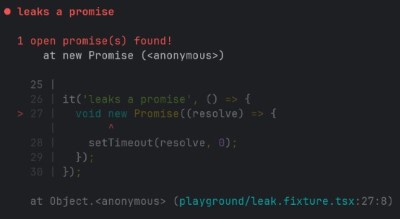
After running tests, a report like this is shown for each detected leak:
🔍 What problems does it catch?
jest-doctor detects common causes of flaky Jest tests by checking that each test fully cleans up its async work and side effects before the next test runs.
It detects and reports when tests:
- Leave unresolved promises
- Leave open real or fake timers
- Leave window DOM listeners attached
- Rely on excessive real-time delays
- Produce unexpected console or process output
Why Jest’s --detectOpenHandles is not enough to prevent flaky tests
Jest already offers a built-in solution to detect open handles. But it often does not report any issues and will not provide actionable advice. The motivation page goes into more detail.
How jest-doctor works
- Patching globals like setTimeout and related APIs
- Tracking async resources created during each test (via
v8.promiseHooksor subclassingPromise) - Checks at test boundaries
- Throws or warns based on configuration
- Optional: Reports through a custom reporter
For a more detailed explanation, see the architecture section.
⚙️ Configuration
The environment can be configured through the Jest config testEnvironmentOptions.
List of all available options:
- report
- console
- processOutputs
- fakeTimers
- timers
- promises
- domListeners
- delayThreshold
- timerIsolation
- clearTimers
- verbose
A detailed description of options can be found at configuration section.
📊 Reporter
The reporter aggregates leaks across all tests and prints:
- Total number of leaks
- Grouped by type (timers, promises, console, etc.)
- Ordered by severity
The environment writes temporary reports to disk and the reporter reads them.
The reporter can be configured using standard Jest reporter configuration syntax.
Options:
- jsonFile:
string: (default: null) File path where a JSON version of the report should be saved. - tmpDir:
string(default:.tmp) Directory used to exchange data between the environment and the reporter. (should be added to.gitignore)
export default {
  reporters: [
    'default',
    [
      'jest-doctor/reporter',
      {
        tmpDir: 'custom-dir',
        jsonFile: 'report.json',
      },
    ],
  ],
};
🚧️ Limitations and known edge cases
No it.concurrent
Concurrent tests cannot be isolated reliably. jest-doctor replaces them with a synchronous version to guarantee deterministic cleanup.
No done callbacks or generators
Callback-style async and generators are legacy patterns and are not supported to keep the implementation reliable and maintainable.
Environment-dependent results
Promise scheduling differs by OS and Node version, so exact leak count, ordering and grouping may vary.
Microtasks resolving in same tick are not tracked
Promise.resolve().then(() => {
  /* i am not tracked as unresolved */
});
Concurrent promise combinators with nested async are problematic
Promise.race, Promise.any, Promise.all cannot safely untrack nested async:
const doSomething = async () => {
  // both promises will be tracked and never released
  await someAsyncTask();
  return new Promise(() => {
    setTimeout(resolve, 10);
  });
};

const p1 = Promise.resolve().then(() => {
  /* this will always be tracked */
});

const p2 = Promise.resolve().then(
  () =>
    new Promise((resolve) => {
      /* this promise will be also always tracked */
      resolve();
    }),
);

await Promise.race([p1, p2, doSomething()]);
Imported timers bypass tracking
Imported timer functions are not intercepted. This can also be used as an escape hatch.
import { setTimeout, setInterval } from 'node:timers';
🚫 When not to use jest-doctor
- Heavy integration tests with background workers
- Tests relying on long-running real timers
- Legacy test suites using callback-based async
In such cases, consider selectively disabling checks or using ignore rules.
💡 Recommendations
- Use ESLint to
- Detect floating promises
- Disallow
setTimeoutorsetIntervalin tests - Disallow console usage
- Only mock console / process output per test not globally, to avoid missing out on errors that are thrown in silence.
- Avoid listening to process.on events like unhandledRejection, because Jest already handles these and failing to unregister handlers can cause memory leaks.
- Enable fake timers globally in config.
🧪 Tested Against
This project is tested against the following combinations:
- Jest: 28, 29, 30
- Node: 20, 22, 24
❓ FAQ
How to migrate an existing project?
Please read the migration guide.
Why is jest-doctor so strict?
Because flaky tests cost more than failing tests.
Does this slow tests down?
Slightly, v8.promiseHooks used for promise detection will have most impact and is turned off by default for that reason.
Instead, use eslint with typescript (recommendedTypeChecked) to avoid floating promises!
What is an async leak?
An async leak happens when a test starts asynchronous work but does not properly wait for or clean it up. This can:
- Interfere with later tests
- Cause flaky failures
- Hide real bugs
Why does console output fail tests?
Treating console output as a leak is a deliberate strictness choice. This enforces explicit assertions and prevents silent failures in CI.
- Prevents polluting the console
- Prevents real bugs from being logged and ignored
The react example shows a common problem that can be caught by tests that mock console correctly.
If jest-doctor helped you eliminate flaky tests, consider ⭐ starring the repo — it helps others discover the project and motivates continued development.